NJ Contractor Tools & Equipment Insurance (Inland Marine).
Your tools, your trailer, your installation floater for materials in transit and on job sites. Standard commercial property doesn’t cover tools off premises — and that’s where most of your tools live. We bundle it in.
Why Standard Property Doesn’t Cover Your Tools
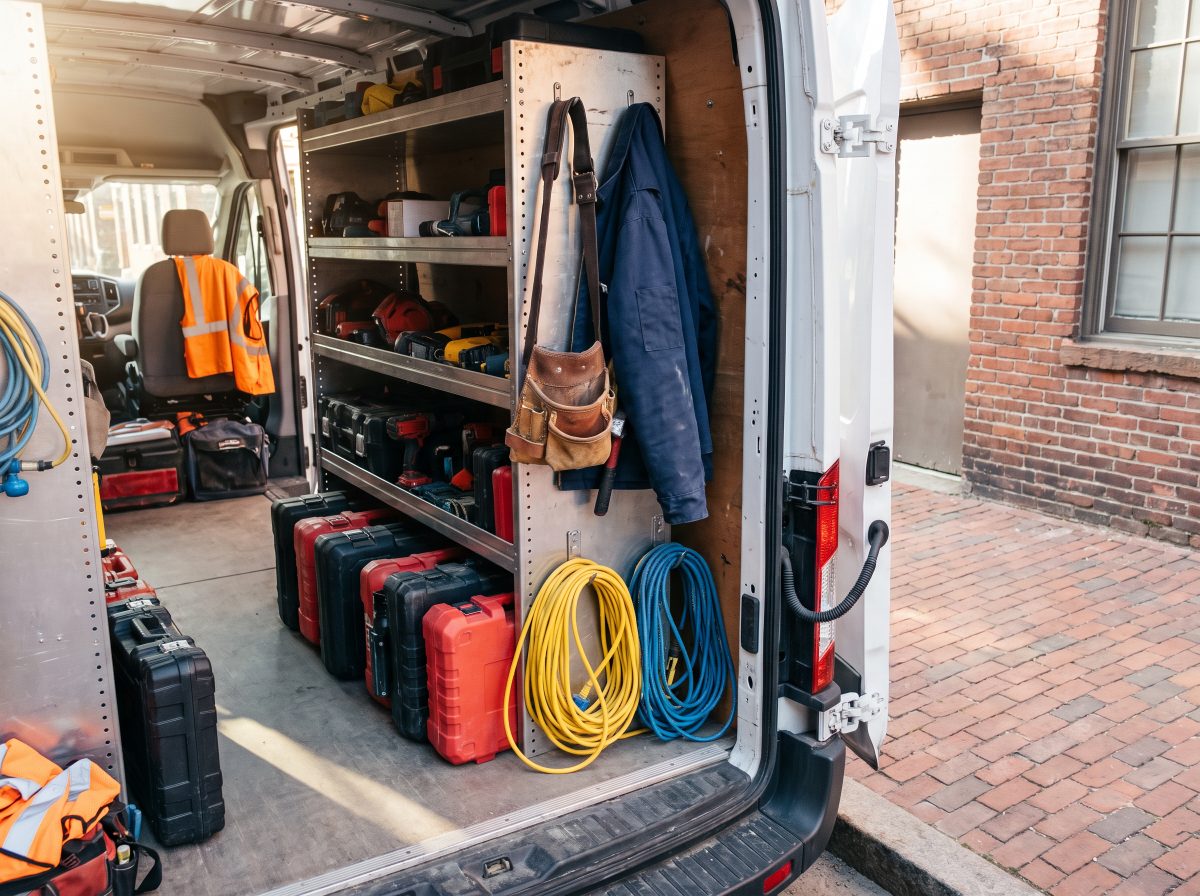
The default commercial property policy covers property at a stated business location. Your tools don’t live there — they live in your truck, on the job site, in your trailer, in transit. The moment they leave the premises, the standard property policy has limited or no coverage.
Inland Marine is the line built for property in transit and at unstated locations. Tools coverage, contractors equipment, installation floater — all forms of inland marine.
What Contractor Tools & Equipment Insurance Covers
- Hand tools & small power tools — covered on a blanket basis up to a limit you select (typically $5K–$25K for small operations).
- Larger equipment — skid steers, mini-excavators, lifts, generators — scheduled (itemized with serial numbers) above $5K each.
- Tools in the truck — covered against theft (subject to the vehicle being locked) and damage.
- Tools on the job site — covered against theft (subject to reasonable security), fire, vandalism, weather.
- Tools in transit — between sites, in the trailer, in another contractor’s truck (with permission).
- Installation Floater — materials you’re installing at a customer location, while in transit and until installed and accepted. Critical for HVAC, plumbing, flooring, and any contractor installing customer-purchased materials.
How Much to Carry
Add up the replacement cost of everything in your truck and trailer right now — tools, ladders, equipment, fall protection, generators, compressors, the works. Round up. That number is your starting limit. Most NJ contractors carry $10K–$50K total tools coverage; commercial mechanical and equipment-heavy trades carry $50K–$250K.
If you have any item worth $5K+ — a thermal imaging camera, a high-end laser level, a specialty saw, a generator — schedule it specifically with serial number. Scheduling does two things: it confirms coverage up to the item’s value, and it speeds up claim settlement.
Installation Floater — The Coverage Most Contractors Don’t Know They’re Missing
You buy $40K of HVAC equipment for a customer install. It’s sitting in your truck. It gets stolen overnight. Your tools coverage covers your tools, not the customer’s materials. Your customer’s homeowners policy doesn’t cover materials not yet installed at their home. Your auto policy doesn’t cover cargo. Installation floater is what bridges that gap.
If you install customer-supplied or contractor-supplied materials at a customer location, installation floater belongs on your policy. We add it by default for any trade where it makes sense — HVAC, plumbing, electrical, flooring, cabinetry, solar, generator install.
Contractors who buy this with us typically also buy:
General Liability
GL covers the third-party damage your operations cause — Tools covers your own tools.
Commercial Auto
Auto covers the truck. Tools covers what’s in it. They’re separate lines.
Builders Risk
Covers the structure under construction; Tools covers the equipment you’re using to build it.
Common questions.
Are my tools covered if they get stolen from a locked job site overnight?
What about tools stolen from my truck?
Do I have to itemize every single tool?
What’s the difference between Tools coverage and Builders Risk?
Can you add a customer’s equipment we’re storing temporarily?
Tools coverage built around how you actually work.
Blanket and scheduled. Installation floater for the lines that need it. Same panel of carriers we use for the rest of your program.